
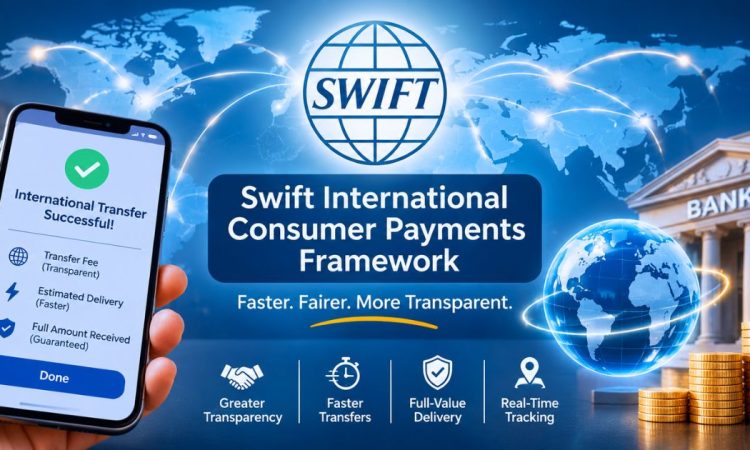

Sending money abroad often feels like a gamble. You choose an amount, press send and hope the right sum arrives on time. The Swift international consumer payments framework aims to change that. No jargon, just the practical detail. It is a new set of shared rules that banks follow when handling everyday cross-border transfers, with the goal of making them faster, clearer and easier to track. Barclays, HSBC, Lloyds Banking Group and NatWest are among the first UK banks to adopt it. This article explains how the framework works, who benefits, what it cannot fix and how to get the best from your own transfers.
What Is the Swift International Consumer Payments Framework?
The Swift international consumer payments framework is a rulebook for banks that handle low value cross-border payments for individuals and small businesses. Swift is the cooperative that runs a secure messaging network linking more than 11,500 financial institutions in over 200 countries and territories.
For decades, those messages worked well between banks. The customer experience was another matter. Fees varied, exchange rates were hard to compare and nobody could say exactly when the money would land.
The new scheme tackles that gap. Swift announced it in September 2025 and built the rules with a voluntary coalition of early adopter banks. Participating banks agree to follow the same standards, so a transfer behaves predictably whichever bank sends it. Swift says the approach could eventually extend to 4 billion accounts across more than 200 countries.
You do not deal with Swift directly. Your bank does. If it takes part, eligible transfers follow the framework’s standards through your usual banking app.
Why Swift Created the Framework
The framework did not appear in isolation. It supports the G20’s goals for cross-border payments, which call for transfers that are faster, cheaper, more transparent and more inclusive.
Demand is also rising. Digital commerce, migration and international trade keep pushing more people and small firms to send payments across borders.
Industry coverage describes the scheme as a shift away from the one-size-fits-all approach that defined cross-border payments for decades. That shift matters because a remittance to family and a supplier invoice have very different needs.
How Does the Swift Consumer Payments Scheme Work?
Think of it as a set of shared promises. Participating banks commit to the same core standards for each eligible payment:
- Upfront costs: the sender sees the fee and exchange rate before confirming.
- Full-value delivery: the recipient receives the promised amount, without hidden deductions along the way.
- Tracking: the sender can follow the payment until it arrives.
- Speed: banks aim for fast delivery, often through local instant payment systems at the receiving end.
Here is a simple example. Suppose you send money to a relative overseas. Your bank shows what you will pay and what your relative will receive. Both figures are clear before you press send. Under the older model, intermediary banks could take small cuts in transit, so the final sum was often a surprise.
Swift also draws on tools it already runs, such as Swift Go, which has served consumer channels for some time. The framework builds on that work with shared network rules.
Which UK Banks Are Using the Framework?
Barclays, HSBC, NatWest and Lloyds Banking Group were among the first UK banks to go live. Industry reports describe a UK minimum viable product, meaning a first working version, delivered in 2026.
The UK rollout starts with specific routes. Swift said customers receiving money from Australia, China, India and Turkey would benefit first, along with those sending money to Australia. So the scheme is not yet available for every country or every customer.
Globally, Swift launched the framework in June 2026, and reports put the number of involved banks above 100. Swift also reported that 26 institutions had begun processing payments, activating 25 corridors. A corridor is simply the route a payment takes between two countries.
Itaú Unibanco in Brazil has gone live, while Bank Alfalah in Pakistan has publicly welcomed the framework. Adoption timelines vary from bank to bank, so check your own provider.
How Faster Payments Fits Into the Picture
The UK link is worth understanding. The framework connects to Faster Payments, the domestic system behind near-instant bank transfers. An incoming international payment can then clear into a local account at domestic speed.
That matters because final-stage delays have long frustrated senders and recipients. A payment could reach the receiving country, then wait for a local bank to credit the account. Instant local rails can remove much of that wait for eligible transfers.
Swift is also working on the next step. It is developing a way for aliases, which are simple identifiers held in domestic systems, to be securely matched for cross-border payments. The aim is to make international transfers feel as easy as domestic ones. This work is still developing, so treat it as a future direction rather than a feature you can use today.
Why the Framework Matters for Everyday Consumers
Three groups stand to gain the most.
Families sending money home. Transfers are often regular and modest, so small charges add up. Clear pricing helps people budget with confidence.
Students and workers. Anyone paying tuition, rent or relatives abroad can see the final cost in advance.
Small businesses. Sole traders who pay overseas suppliers should get more predictable payments instead of waiting and wondering.
The framework also aligns with the Financial Conduct Authority’s Consumer Duty, which came into force in July 2023. That duty expects firms to deliver good outcomes and clear communication. Showing the total cost upfront fits that approach neatly.
What the Framework Does Not Change
Realistic expectations matter, so here are the limits.
- It does not make every transfer instant. Speed still depends on the route, the receiving bank and local systems.
- It does not guarantee the cheapest option. It promises clarity, not the lowest price.
- It does not cover every route yet. Results vary by bank, country and payment type.
- It targets low-value payments. Large business transfers follow different processes.
Swift is also exploring a blockchain based shared ledger. That is a separate, longer-term project and not part of the consumer scheme itself.
How to Get the Best From International Transfers Today
Whatever route you use, a few habits help.
- Check the total cost, not just the fee. Compare the exchange rate with the mid-market rate from a reliable source.
- Ask your bank whether your route uses the Swift framework.
- Check the recipient’s details carefully. A single wrong digit can cause delays.
- Keep your payment reference so you can track the transfer.
- Watch for scams. Use only your bank’s official app or website, and never share security codes.
Consider the speed you need as well. If a payment is urgent, ask the bank for the expected delivery time before you confirm.
Finally, remember that transparency is only useful if you read it. Take a moment to compare the quoted figures with another provider before you commit.
Frequently Asked Questions
Is the Swift international consumer payments framework available in the UK?
Yes, in part. Barclays, HSBC, Lloyds Banking Group and NatWest have started adopting it, initially for selected routes. Availability depends on your bank, the destination country and the payment type.
Do I need to sign up with Swift to use the framework?
No. Swift works with banks, not individuals. If your bank participates, eligible transfers should follow the framework’s standards when you send money through your usual banking app.
Will the framework make international transfers cheaper?
Not necessarily. Its main promise is price clarity, so you see the fee and exchange rate upfront. Comparing providers can still help you find a better overall deal.
What is a cross-border payment corridor?
A corridor is the route a payment takes between two countries, such as the UK to India. Each corridor can involve different banks, rules and timings.
Can I track an international transfer under the framework?
Yes, tracking is one of its core standards. Participating banks aim to let senders follow a payment until it arrives, though the level of detail you see depends on your bank’s app.
Conclusion
The Swift international consumer payments framework brings a simple idea to cross border banking: tell customers what will happen before it happens. Upfront fees, full value delivery and tracking are practical gains for families, students and small firms.
UK adoption by Barclays, HSBC, Lloyds Banking Group and NatWest is a promising start, though coverage is still limited to selected routes. It will not guarantee the cheapest or fastest transfer every time, so comparing options still pays off. Watch your bank’s announcements as the scheme grows, and sending money abroad may soon feel far more certain.
for more information click here