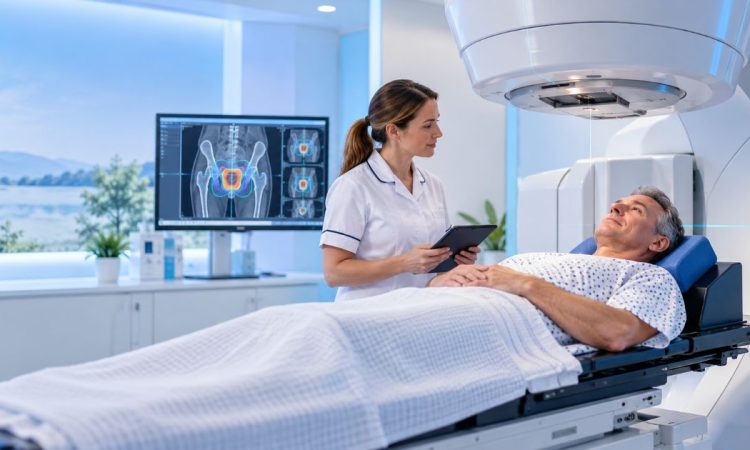

Stereotactic radiotherapy UK men with early prostate cancer can ask about is now reaching NHS patients in England. In June 2026, NHS England announced that eligible men will be offered stereotactic ablative radiotherapy (SABR) at all 48 of its radiotherapy centres. The headline change is speed. Treatment usually takes five visits over about two weeks, compared with at least 20 for standard radiotherapy. This article explains what SABR is, who may qualify, what happens during treatment and which questions to ask your care team. It is general information, not medical advice, so your specialist will always have the final say.
What is stereotactic radiotherapy?
Stereotactic radiotherapy is a type of external radiotherapy. It aims many carefully shaped beams at a tumour from different angles. Each beam is fairly weak on its own. Where they all meet, the dose is high. Healthy tissue nearby receives far less.
The word “stereotactic” refers to three-dimensional mapping. Scans pinpoint the tumour, and planning software shapes the beams to match it. The machine then moves around you, delivering the dose with millimetre-level accuracy.
When the aim is to destroy a tumour with high doses, doctors call it SABR, short for stereotactic ablative radiotherapy. “Ablative” simply means removing or destroying tissue. NHS teams already use SABR for some lung and brain cancers. Prostate cancer is now the latest major addition for men in England.
You may also see the term SBRT, or stereotactic body radiotherapy. It describes the same approach used on tumours outside the brain.
How is SABR different from standard radiotherapy?
Standard external beam radiotherapy gives small daily doses over around four weeks. That usually means at least 20 hospital visits. SABR delivers larger doses in far fewer sessions, typically five over about a fortnight.
The main differences are:
- Fewer visits: five sessions instead of 20 or more, which means less travelling and less time away from work.
- Higher dose per session: each visit delivers more radiation to the tumour.
- Tighter targeting: beams are shaped closely around the prostate to protect nearby tissue.
- Same goal: to control or cure cancer that has not spread beyond the prostate.
The change follows the PACE-B trial, supported by Cancer Research UK. It found that five-session SABR can treat many small, low-risk prostate cancers effectively. Some news reports describe fewer side effects, but side effects can still happen, so ask your team what to expect in your case.
Who can have stereotactic radiotherapy for prostate cancer?
NHS England has approved SABR for men with localised prostate cancer at low or intermediate risk. Localised means the cancer has not grown outside the prostate. About 17,500 men in England receive this type of diagnosis each year. NHS modelling suggests around 3,500 of them, roughly one in five, may choose SABR.
Not every man will be suitable. Your team will look at several factors:
- your PSA level (prostate-specific antigen, a protein measured in a blood test)
- biopsy results and cancer grade
- MRI scan findings
- prostate size and urinary symptoms
- your general health and personal preferences
Some men with very low-risk cancer may be offered active surveillance, which means regular monitoring without immediate treatment. Others may need hormone therapy alongside radiotherapy, or a different treatment altogether. Surgery is another option, and a specialist can explain how it compares.
Men whose cancer has already spread are not covered by this approval. Prostate Cancer UK says it is investing in research to see whether more men could benefit.
Stereotactic radiotherapy UK men: is it available everywhere?
The announcement applies to England. Health services are devolved, so men in Scotland, Wales and Northern Ireland should ask their local cancer team about availability.
In England, NHS England said all 48 radiotherapy centres would offer SABR to eligible men within three months of the June announcement, with some starting within weeks. Rollout will not be identical everywhere. The Royal United Hospitals Bath, for example, treated its first prostate SABR patient in July 2026.
If you have been diagnosed, ask your consultant whether your local centre offers it yet. You can also ask whether referral to a nearby hospital is possible. Some private hospitals offer stereotactic radiotherapy too. Costs vary, so ask for a written quote before agreeing to anything.
What happens during SABR treatment?
Every hospital has its own routine, but the process usually follows these steps:
- Planning scans. You will have a CT scan and often an MRI scan so the team can map your prostate precisely.
- Preparation. Some men have tiny markers placed in the prostate to guide the beams. Others have a spacer gel inserted to move the rectum slightly away from the prostate. Not everyone needs these.
- Bladder instructions. You may be asked to arrive with a comfortably full bladder and to follow a bowel routine.
- Treatment visits. You lie still on the couch while the machine moves around you. It is painless and quick, although each appointment includes set-up time.
- Follow-up. Your team will monitor your PSA level and symptoms over the following months and years.
You are not radioactive afterwards, so it is safe to be around family and children.
What side effects can men expect?
Radiotherapy affects healthy tissue near the prostate as well as the tumour. Side effects usually fall into a few groups:
- Urinary: needing to pass urine more often or urgently, or a burning feeling.
- Bowel: looser stools, urgency or, less commonly, some bleeding.
- Sexual: erection difficulties can develop over time.
- General: tiredness is common during and after treatment.
Many early effects settle within weeks or months. Some can last longer or appear later. Tell your care team about any new symptoms, particularly blood in your urine or stool, as they can often help.
Questions to ask your care team
A consultation can feel overwhelming, so write your questions down beforehand. Useful ones include:
- Am I suitable for SABR, or would standard radiotherapy suit me better?
- Will I need hormone therapy as well?
- How will you monitor my PSA after treatment?
- What side-effect rates do you see at this centre?
- Can I get help with travel costs?
Bringing a partner, relative or friend can help. Charities such as Prostate Cancer UK and Macmillan Cancer Support run helplines for men who want to talk things through.
Why this matters for men across the UK
Prostate cancer is the most common cancer in men in the UK. More than 55,000 men are diagnosed each year, and around 12,300 die from it. Fewer hospital visits could ease the burden on patients, families and busy radiotherapy departments.
NHS England estimates the change could free up around 50,000 appointments a year, which may help shorten waiting lists.
Awareness matters too. Prostate cancer often causes no early symptoms. Men over 50, Black men and those with a family history can speak to their GP about the pros and cons of a PSA test. Catching the disease early gives more treatment choices.
Frequently Asked Questions
What is SABR for prostate cancer?
SABR stands for stereotactic ablative radiotherapy. It delivers high, precisely targeted radiation doses from many angles, usually in five sessions, to treat early prostate cancer while limiting damage to nearby healthy tissue.
How many sessions does stereotactic radiotherapy involve?
For prostate cancer, SABR is typically given as five sessions over about two weeks. Standard external radiotherapy usually needs at least 20 visits, so the shorter course reduces travel and time away from work.
Is stereotactic radiotherapy for men available on the NHS?
Yes, in England. NHS England is rolling it out to eligible men with low or intermediate-risk localised prostate cancer. Availability elsewhere in the UK depends on local health services, so ask your cancer team.
Does SABR cure prostate cancer?
It aims to destroy localised tumours and stop them spreading, and trial results are encouraging. No treatment guarantees a cure, so regular PSA follow-up is essential. Your consultant can discuss your outlook.
Conclusion
Stereotactic radiotherapy UK men can now discuss with their doctors marks a significant step forward. SABR offers a shorter course of five visits, delivered with high precision, and trial evidence supports its use for suitable low and intermediate-risk disease. It will not suit everyone, and side effects are still possible. The best next step is an open conversation with your specialist team about your cancer, your priorities and your options. With clear information and the right questions, you can choose the treatment that fits your life.
for more information click here