
If you have been searching for stopwatt reviews, chances are you have seen the same promise again and again: plug a small device into your wall socket and supposedly watch your electricity bill fall. With household energy costs still a concern for many people, I can understand why that sounds tempting.
But does StopWatt actually reduce the amount of electricity a typical UK home uses? And are those impressive savings backed by reliable evidence?
I decided to look beyond the sales pitch and compare the claims with customer feedback and practical energy-saving advice. What I found is worth knowing before you put your card details into an online checkout.
StopWatt Reviews: What Is StopWatt Supposed to Do?
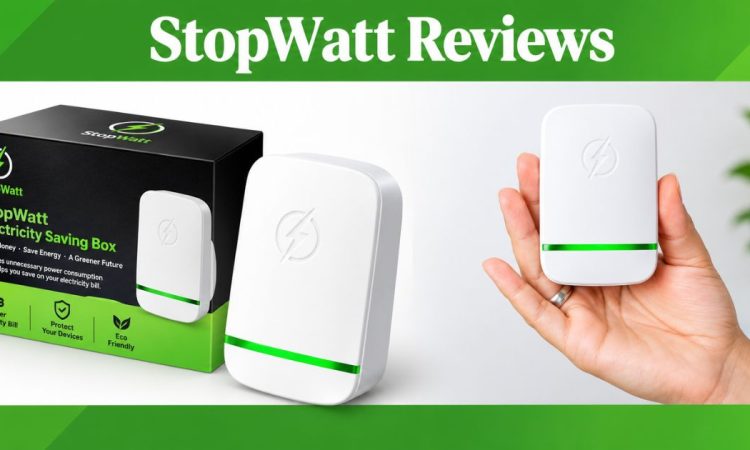
StopWatt is marketed as a small plug-in electricity-saving device. The official sales material says it uses a capacitor to stabilise power flow, reduce supposedly wasted energy and protect household appliances. It also claims that simply plugging the device into an outlet can help lower your electricity bill.
That sounds wonderfully simple. After all, who wouldn’t want to save money without replacing appliances or changing daily habits?
The problem is that the marketing claim and the evidence are two different things.
A key question is this: Can a small device plugged into one socket really make a substantial difference to the total electricity recorded by your household meter?
For most households, electricity consumption comes from appliances actually doing work. Heating, cooling, refrigeration, washing machines, tumble dryers, lighting and other equipment all contribute to your usage. Energy Saving Trust notes that a relatively small number of household appliances account for a large share of domestic electricity consumption, particularly equipment that heats, cools or runs continuously.
That is why I would be cautious about treating a plug-in gadget as a substitute for tackling the appliances that genuinely consume energy.
What Do Customers Say?
This is where StopWatt customer reviews become particularly interesting.
At the time of writing, Trustpilot shows StopWatt with a 1.5 out of 5 TrustScore from 76 reviews. Of those reviews, 95% are rated one star. Customers commonly complain that the device did not reduce their electricity bills, while others mention concerns about ordering, charges, refunds and customer support.
Of course, online reviews have limitations. A review website is not a scientific laboratory, and dissatisfied customers may be more motivated to leave reviews than satisfied ones. Trustpilot itself says that reviews represent individual opinions and may not necessarily be representative.
Still, a large concentration of negative feedback is something I would not ignore.
When I researched StopWatt, one thing stood out to me: many of the strongest claims are made in advertising, while independent evidence showing substantial reductions in real household kWh consumption is much harder to find.
That’s an important distinction.
A glowing LED on the device proves that electricity is reaching the gadget. It does not, by itself, prove that your home is consuming substantially less electricity.
Does StopWatt Really Save Electricity?
This is probably the biggest question behind searches for does StopWatt really work.
The official website describes the device as improving power flow and reducing wasted energy. However, I could not find convincing independent evidence demonstrating that StopWatt produces the dramatic household electricity savings suggested by some promotional material.
There is also an important technical point to understand.
Terms such as “power factor correction”, “dirty electricity” and “voltage stabilisation” can sound highly technical. But technical language should not automatically be confused with proof of lower household energy consumption.
For a normal domestic customer, your electricity bill is based on measured energy consumption. So the meaningful test is not whether the gadget appears to alter electrical conditions in some way. The meaningful test is whether your household’s actual electricity consumption falls measurably under controlled, comparable conditions.
An expert tip here is simple: look at kWh, not marketing percentages. Compare your actual meter readings or smart-meter data over comparable periods, taking weather and appliance use into account.
That gives you something measurable rather than relying on a testimonial.
Common Mistakes When Buying Energy-Saving Gadgets
There are a few traps worth watching for.
1. Believing a percentage without seeing the evidence
A claim such as “save up to 40%” sounds impressive. But “up to” can cover a huge range, and it does not tell you what the average household actually saves.
Before believing a number, ask: Was it independently tested? Where was the test conducted? What type of home was involved? Was electricity consumption measured in kWh?
2. Confusing appliance protection with energy savings
A product may claim to protect appliances from surges or improve power quality. Even if a device performs some electrical function, that does not automatically mean your overall electricity consumption will fall significantly.
These are separate claims and should be assessed separately.
3. Assuming customer testimonials are proof
Testimonials can be useful for understanding someone’s experience, but they aren’t controlled experiments.
If someone says their bill fell by £100 after installing StopWatt, that does not prove StopWatt caused the reduction. Their heating use, weather, tariff, occupancy or appliance use could all have changed.
4. Ignoring the actual cost
An energy-saving gadget only makes financial sense if the saving is greater than the purchase price.
If you’re spending money on a product promising dramatic savings, calculate the break-even point first. How many months would it take to recover the cost?
That simple calculation can prevent an impulse purchase.
Better Ways to Reduce Your Electricity Bill
If your goal is genuinely to lower household energy consumption, there are approaches with a much clearer connection to electricity use.
Start with the appliances that consume the most energy. Energy Saving Trust identifies washing machines, dishwashers, tumble dryers, fridges and freezers among significant household energy users, alongside appliances used for heating and cooling.
You can also:
- Replace inefficient bulbs with LEDs.
- Avoid running washing machines and dishwashers half empty.
- Use eco settings where practical.
- Reduce unnecessary tumble-dryer use.
- Turn off equipment rather than leaving it running unnecessarily.
- Check your fridge and freezer temperatures.
- Use smart-meter information to identify periods of high consumption.
- Compare your actual kWh usage rather than simply comparing monthly bills.
I particularly like the smart-meter approach because it gives you real information about your own home. Instead of asking, “Does this gadget save electricity?”, you can ask, “Where is my electricity actually going?”
That is a much more useful question.
StopWatt Reviews: My Take Before You Buy
After looking at the available information, I would not buy StopWatt solely on the promise of dramatically lower electricity bills.
The product is certainly marketed as an energy-saving device, and its website describes a specific mechanism involving power stabilisation and a capacitor. However, the independent evidence I found does not give me enough confidence to accept the headline savings claims.
The customer feedback is another reason for caution. Trustpilot currently contains a strong concentration of one-star reviews, with repeated complaints about effectiveness and purchasing experiences.
There is also a wider reason to be careful. Recent reporting has highlighted concerns about other plug-in “energy-saving” products sold online, including devices criticised over effectiveness and electrical safety.
So, if you are considering buying one, don’t let a countdown timer, dramatic testimonial or big percentage saving rush your decision.
FAQ
1. Is StopWatt a genuine product?
StopWatt is sold as a physical plug-in electricity-saving device, so the existence of a product does not necessarily answer whether its advertised savings are genuine. The more important question is whether independent evidence supports its claimed reduction in household electricity consumption.
2. Can StopWatt reduce my electricity bill?
There is not enough convincing independent evidence for me to recommend relying on StopWatt to reduce a typical UK household electricity bill. Customer feedback currently contains many complaints from buyers who say they saw no meaningful saving.
3. What is the best way to reduce electricity use?
Start by identifying which appliances consume the most energy and changing their use where possible. Energy Saving Trust recommends focusing on energy-efficient appliances and sensible appliance use, particularly for equipment that heats, cools or runs frequently.
Conclusion
My research into stopwatt reviews leaves me cautious about the product’s headline energy-saving claims. The marketing sounds attractive, but strong claims need strong independent evidence, and I haven’t found enough to justify relying on StopWatt for major bill reductions. Customer feedback is also overwhelmingly negative at the time of writing. If your aim is to cut energy costs, start with measurable changes: monitor your kWh use, target energy-hungry appliances and make practical efficiency improvements. Your meter is a far better guide than a sales promise.