
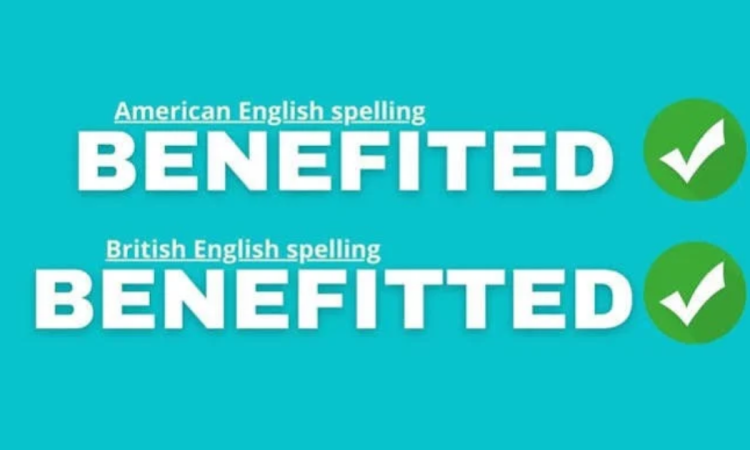

Should you write benefitted or benefited? Short answer: benefited is the standard spelling in British English, and it is the safer choice for emails, reports and websites. Benefitted appears in print, and some dictionaries list it as a variant, but most style guides steer writers towards the single-t form.
The confusion is understandable. English spelling rules about doubled consonants are messy, and “benefit” sits right in the middle of them. This article explains the rule, shows when it applies, and gives you simple ways to get it right every time. You will also see how the same rule works for similar words.
Benefitted or Benefited: The Quick Answer
Use benefited. It is the past tense and past participle of the verb “to benefit”, and it carries one t before the -ed ending. The same applies to the -ing form: benefiting, not benefitting.
Here are some examples:
- Local families benefited from the new bus route.
- She has benefited from regular coaching.
- Small businesses benefited when the council cut parking charges.
Benefitted is not a serious error, and you may see it in older texts or informal writing. Still, a proofreader or editor working to UK standards will usually change it. If you want clean, professional copy, choose the single-t spelling.
Why Benefited Has Only One T
English has a well-known rule for adding endings such as -ed and -ing. If a verb ends in a single vowel plus a single consonant, you double the consonant only when the stress falls on the last syllable.
Take “begin”. The stress sits on the second syllable: be-GIN. So you write “beginning”. The same goes for “prefer”, which becomes “preferred”, and “admit”, which becomes “admitted”.
Now look at “benefit”. Say it aloud and the stress lands on the first syllable: BEN-e-fit. The final syllable is weak and unstressed. Because the stress is not at the end, the final consonant stays single. That gives you “benefited” and “benefiting”.
This is the same reason we write “visited”, “limited” and “profited” rather than “visitted”, “limitted” or “profitted”. Once you know the pattern, the spelling stops feeling random.
Why Some Writers Still Use Benefitted
If the rule is so clear, why does benefitted keep appearing? There are a few reasons.
First, spelling habits vary. Many writers add a second t because the word looks like it should be doubled, especially when typing quickly. Second, English has plenty of exceptions, so people assume this is one of them. It is not.
Third, benefitted has a history in print. Some dictionaries record it as an accepted variant, which is why you will find it in published work. Variant does not mean preferred, though. Dictionaries and style guides generally put benefited first.
Spellcheckers can add to the confusion. Depending on the dictionary installed, some tools accept both forms without comment. A missing red underline does not prove a spelling is the best choice. Autocorrect and predictive text can also nudge writers towards whichever form they typed before, which spreads the habit.
Benefit, Benefits, Benefited and Benefiting
The word “benefit” works as both a noun and a verb, so it helps to see every form together.
- Benefit (noun): the advantage you gain. “The scheme has clear benefits.”
- Benefit (verb, present): to gain an advantage. “Pupils benefit from smaller classes.”
- Benefits (noun or verb): “She benefits from flexible hours.”
- Benefited (past): “Pupils benefited from smaller classes last year.”
- Benefiting (-ing form): “Shoppers are benefiting from lower prices.”
Notice that the noun “benefit” also has a special UK meaning. In Britain, “benefits” often refers to state payments such as Universal Credit. That is a different sense, but the spelling stays the same.
The noun forms never cause trouble. The problem only arises with the past tense and the -ing form, where writers wonder whether to double the t.
Similar Words That Follow the Same Pattern
Benefit is not alone. Many common words with stress on an earlier syllable keep a single consonant before -ed or -ing.
- Target becomes targeted and targeting.
- Budget becomes budgeted and budgeting.
- Market becomes marketed and marketing.
- Credit becomes credited and crediting.
- Visit becomes visited and visiting.
Compare those with words stressed on the final syllable, which do double the consonant:
- Commit becomes committed and committing.
- Permit becomes permitted and permitting.
- Refer becomes referred and referring.
British English adds one more twist. Verbs ending in a single l usually double it, even when the stress is early. So “travel” becomes “travelled” and “cancel” becomes “cancelled”. American English normally keeps one l. This l rule does not affect benefit, but it explains why UK spelling can feel inconsistent.
A few other words, such as “worship”, double the final consonant in British English: worshipped. Others, such as “handicap”, double it everywhere: handicapped. These are exceptions you simply need to learn.
Is Benefited Spelled Differently in British and American English?
Many readers assume benefitted is the British choice and benefited the American one. That is not quite right. Benefited is the main spelling in both varieties. Benefitted is a minor variant that turns up on both sides of the Atlantic.
This makes the word different from “colour” and “color”, or “organise” and “organize”, where the dividing line is clearer. With benefit, there is no strong regional split. There is simply a preferred form and a less common one.
For a UK audience, choosing benefited gives you consistency with major dictionaries and with the way most British writers spell it. If you publish for readers in several countries, the same choice works everywhere. You do not need separate versions.
Common Phrases Using Benefited
Writers most often use the verb with “from”. Seeing it in real sentences helps the spelling stick.
- Benefited from: “The school benefited from a new grant.”
- Have benefited: “Many commuters have benefited from the extended railcard discount.”
- Who benefited: “Nobody could say who benefited most from the change.”
- Greatly benefited: “Patients greatly benefited from the faster appointments.”
You can also use the noun form in phrases such as “benefit of the doubt”, “for the benefit of” and “benefit in kind”. In UK tax, a benefit in kind means a non-cash perk from an employer, such as a company car. The spelling is still just benefit.
Be careful with look-alike words too. “Benefice” means a church position and has nothing to do with advantage, while “beneficial” is an adjective meaning helpful. Neither takes a double t.
Simple Ways to Remember the Right Spelling
A few quick habits can save you from second-guessing yourself.
Say it out loud. Notice where your voice puts the weight. In “benefit”, it falls at the start, so the final t stays single.
Compare with “profit”. Few people write “profitted”. If profited looks right, benefited does too, because the two words share the same ending and stress pattern.
Use a house style. If you write for work, check your organisation’s style guide. If it names a dictionary, use that dictionary’s first-listed spelling.
Search and replace. Before publishing, run a quick find for “benefitt”. It takes seconds and catches stray errors.
Consider rewording. If you remain unsure, swap in “gained”, “helped” or “improved”. Varied language also keeps your writing fresh.
Frequently Asked Questions
Is benefitted a real word?
Yes, some dictionaries list it as a variant spelling. However, benefited is the standard form, so use that in professional writing, essays and website content. Most readers expect it.
Is it benefited or benefitted in British English?
British English uses benefited. The stress falls on the first syllable of “benefit”, so the final consonant is not doubled before -ed or -ing. Benefitted is a less common variant.
Is it benefiting or benefitting?
Benefiting is the standard spelling, for the same stress reason. One t sits before -ing, just as it does in “visiting”, “limiting” and “budgeting”. Benefitting is rarer.
How do you use benefited in a sentence?
Use it as a past tense verb, usually with “from”. For example: “The village benefited from the new cycle path.” It can also follow “has” or “have”.
Conclusion
The answer to benefitted or benefited is simple: write benefited. It follows the stress rule that keeps the final consonant single when the emphasis falls early in the word, just like “visited” and “budgeted”. Benefitted exists as a rare variant, but it seldom suits professional UK writing. Remember to listen for the stress, compare it with similar words, and check your house style when in doubt. Small details like this build trust in everything else you publish. Choose benefited, and your readers will notice the clarity, not the spelling.